
Guests staying at Case Graziani, in the heart of the countryside between Umbria and Tuscany, are in a privileged position to discover some of the most fascinating historic villages in central Italy. Alongside beautiful landscapes, castles, wineries and local food, the area also offers a rich heritage of folk traditions and historical reenactments that are still deeply rooted in the local communities.
Among these traditions, a special place is occupied by the Palios, jousts and competitions between contrade (historic districts) and terzieri (traditional city districts) that bring the historic centres of the Valdichiana and surrounding areas to life throughout the year.
From the Palio dei Terzieri in Città della Pieve to the Giostra del Saracino in Sarteano, and from the Bravìo delle Botti in Montepulciano to the famous Palio di Siena, these events offer a unique and engaging way to discover the history and traditions of this fascinating part of Italy.
What is a Palio and where does this tradition come from?
The word Palio comes from the Latin pallium, meaning “cloth” or “banner”. In ancient times and during the Middle Ages, a precious piece of fabric was often awarded as the prize to the winner of a competition.
Over time, the word Palio came to refer not only to the prize itself, but also to the competition and the entire festival surrounding it.
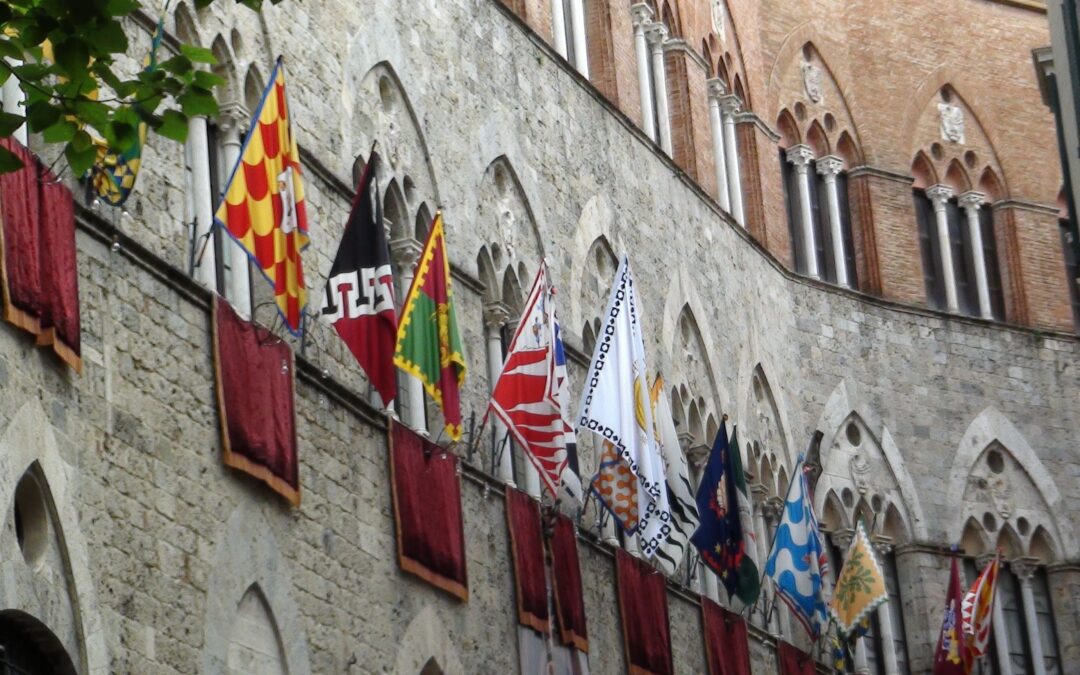
In many towns throughout central Italy, these traditions have survived for centuries, becoming important cultural and tourist events. Modern competitions often preserve elements of medieval and Renaissance celebrations, including historic costumes, processions, drums, flag throwers, knights and traditional competitions.
The tradition is particularly strong in Tuscany and Umbria, where many towns and villages still organise historical reenactments involving the local population.
The Palio dei Terzieri in Città della Pieve
The Palio closest to Case Graziani is undoubtedly the Palio dei Terzieri in Città della Pieve, one of the most important historical events in the area.
During the Palio, Città della Pieve seems to travel back in time to the Middle Ages.
The town is divided into its three historic districts, known as Castello, Borgo Dentro and Casalino, which compete against each other through a series of events and challenges.
One of the most characteristic competitions is the Caccia del Toro, in which archers representing the three districts compete by shooting at targets depicting Chianina cattle.
But the Palio is much more than a competition.
For several days, the historic centre of Città della Pieve comes alive with costumed processions, performances, traditional games, banquets, music, drums and events inspired by medieval life.
We have dedicated a full article on our blog to this fascinating event: The Palio dei Terzieri: a journey back to the Middle Ages in Città della Pieve.
For guests staying at Case Graziani, this is probably the first Palio to add to their holiday calendar.
The Giostra del Saracino in Sarteano
Just a few kilometres from Città della Pieve, crossing the border between Umbria and Tuscany, lies Sarteano, a beautiful historic village dominated by its ancient fortress.
Every year, on 15 August, the spectacular Giostra del Saracino takes place. This traditional event is inspired by the ancient equestrian tournaments of the Middle Ages and Renaissance and is considered one of the most important events in the social life of Sarteano.
The competition features knights representing the town’s five contrade. Riding at full speed, each knight must use his lance to strike a ring attached to the shield of the Buratto, a statue representing the Saracen warrior.
Hitting the target is not the only challenge. If the knight misses, the Buratto can spin around and strike him with its own mace.
The result is a spectacular competition, preceded by an impressive historical procession featuring period costumes.
The Giostra del Saracino is therefore one of the most interesting events to experience during a summer holiday in the Valdichiana.
You can also discover more about the area’s history in our article about the Castle of Sarteano, which dominates the town from the top of the hill.
The Bravìo delle Botti in Montepulciano
If there is one truly unusual Palio near Case Graziani, it is the Bravìo delle Botti in Montepulciano.
There are no horses and jockeys here. Instead, the protagonists are large wine barrels, pushed uphill through the steep streets of Montepulciano’s historic centre by pairs of competitors known as spingitori.
The Bravìo involves the eight historic contrade of Montepulciano and is one of the best-known traditional events in the Valdichiana Senese.
The most distinctive feature of the competition is its uphill route through the historic centre, ending in the spectacular Piazza Grande.
Every year, Montepulciano hosts an entire week of events, including historical processions, performances, activities organised by the contrade and, of course, the barrel race.
The Bravìo is also an excellent opportunity to combine history and Tuscan food and wine, perhaps by visiting one of the many wineries producing the renowned Vino Nobile di Montepulciano.
Montepulciano is one of the destinations we regularly recommend to guests staying at Case Graziani and is easily accessible from our agriturismo.
The Palio di Siena: the most famous Palio
When talking about Palios in Tuscany, it is impossible not to mention the Palio di Siena, probably the most famous Palio in the world.
The race traditionally takes place twice a year, on 2 July and 16 August, and features ten of Siena’s seventeen historic contrade. The horses are assigned to the contrade by lottery, and the race takes place in the spectacular setting of Piazza del Campo.
The origins of the event are extremely old. Over the centuries, the tradition in Siena developed into one of Italy’s most famous and recognisable historical events.
The Palio di Siena is undoubtedly the best known, but the smaller towns of the Valdichiana offer visitors the opportunity to discover perhaps an even more authentic side of this tradition: festivals that are organised and experienced directly by the local communities.
Palios and historical reenactments: a living heritage
The appeal of the Palios goes far beyond the competition itself.
These events provide an opportunity to rediscover the history, traditions, costumes and identity of Italy’s small historic towns. The contrade and terzieri are not simply teams taking part in a competition. They represent an important part of the local community and often organise events and activities throughout the year.
For this reason, attending a Palio is not simply about watching a competition. It is an opportunity to experience the life of the town, even if only for a few hours.
Historical processions, period costumes, flags, drums, dinners organised by the contrade and performances transform the historic centres into spectacular open-air stages.
When can you see the Palios near Case Graziani?
The richest period for these events is naturally summer, particularly between July and August.
The Palio dei Terzieri in Città della Pieve, the Giostra del Saracino in Sarteano and the Bravìo delle Botti in Montepulciano are three of the most interesting events to consider when planning a holiday between Umbria and Tuscany.
It is no coincidence that, in our article about Ferragosto at an agriturismo, we also recommend the Giostra del Saracino and the Palio dei Terzieri among the events not to be missed during a summer stay.
The location of Case Graziani makes it easy to combine relaxing days at the agriturismo with visits to historic villages and local festivals.
Case Graziani: the perfect base for discovering Umbria and Tuscany
Staying at Case Graziani means being in a strategic location between Città della Pieve, Chiusi, Lake Trasimeno and Tuscany.
From here, guests can easily plan day trips to Montepulciano, Pienza, Sarteano, Chiusi, Cortona, Castiglione del Lago, Perugia and Siena, combining days dedicated to culture and local traditions with relaxing moments in the countryside.
Our agriturismo between Umbria and Tuscany offers independent apartments, a swimming pool, sauna, play area and outdoor spaces: the ideal solution for those who want to discover the area without giving up the peace and relaxation of the countryside.
The Palios are therefore much more than simple competitions: they are a gateway to the history and culture of central Italy.
And if, during your holiday, you happen to hear the sound of drums, see a historical procession passing through the streets or come across a contrada preparing for its annual celebration, stop and take a look.
You may discover one of the most authentic and fascinating aspects of the Valdichiana between Umbria and Tuscany.